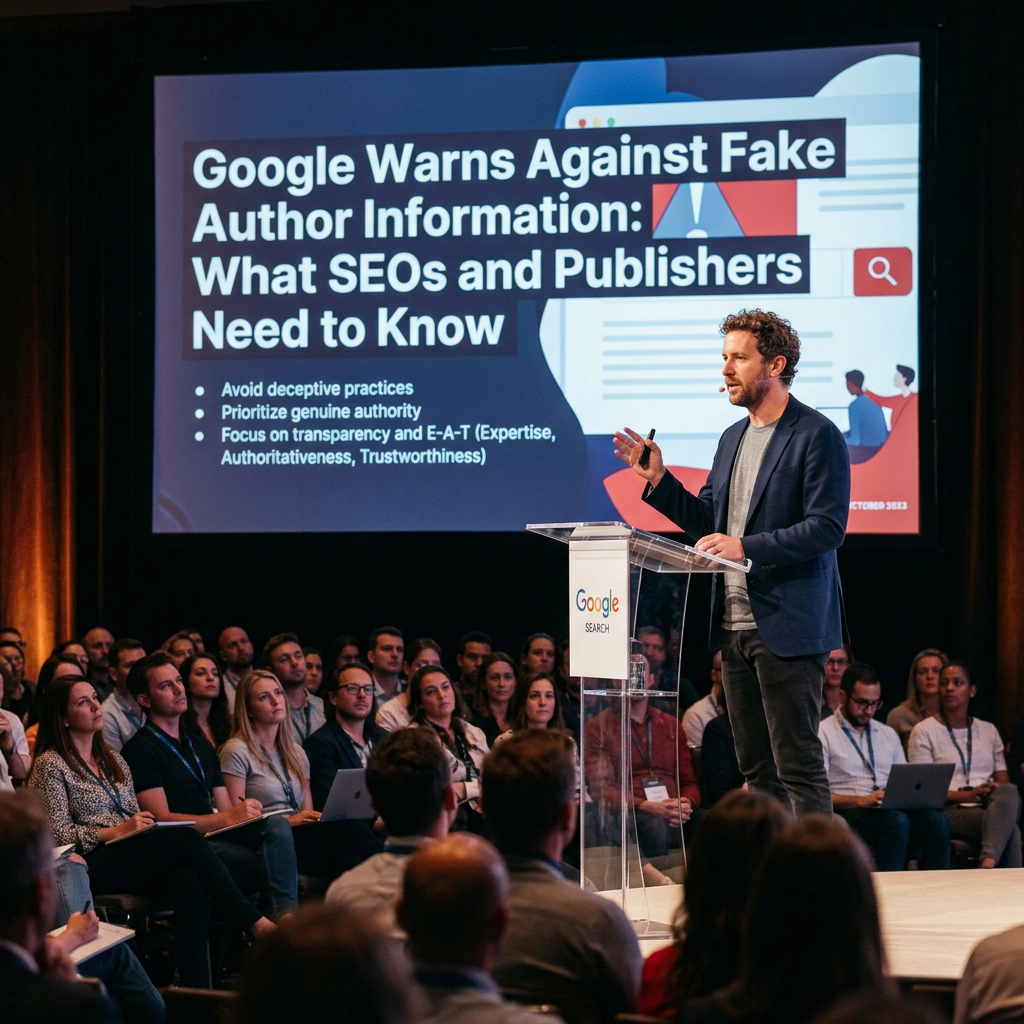
For years, SEOs have been told to show experience, expertise and trust through author bylines, bios and credentials. Some publishers took the shortcut. They invented writers, generated headshots with AI and attached impressive-sounding qualifications to articles that no such person ever wrote.
Google has now addressed this directly in its documentation.
What Google changed
In early October 2026, Google updated its creating helpful, reliable, people-first content guidance. Search Engine Land’s Barry Schwartz reported that the update adds a new paragraph under the “who, how and why” section. The paragraph opens with a clear instruction: “Avoid using deceptive authorship information.”
Google then spells out what counts as deception. Fabricating creator profiles is one form, and the document names AI-generated headshots, made-up names and false credentials used to make content look like it was written by human experts.
Google also explains the consequence. Any form of deception makes a page untrustworthy, both to users and to Google’s automated quality systems, and the documentation describes it as a signal of a low-quality page.
Why this matters
1. It’s now written policy, not just a hunch. SEOs have long suspected that fake bylines were risky. Google has now put into its own documentation that fabricated authorship is deceptive and reads as a low-quality signal.
2. The problem is widespread. Schwartz notes that it’s “pretty wild” how many fake author profiles currently sit on content from news-oriented sites. A clear statement from Google suggests this is something it is paying attention to.
3. The risk may reach beyond one page. Schwartz warns that Google could decide the website’s overall quality is low, not just the page carrying the fake author. Google’s wording is about pages, so treat the sitewide effect as a risk to plan around rather than a confirmed mechanism.
4. It lands in the middle of the AI content debate. Fake authorship and mass-produced AI content often travel together. AI-generated headshots, invented personas and unverifiable credentials are exactly what lets thin content pass as expert-written. Google isn’t saying AI-assisted content is banned. It’s saying that disguising who or what produced the content is deceptive.
What counts as “deceptive authorship”?
Based on Google’s own examples, these are the red flags:
- Made-up author names with no real person behind them
- AI-generated headshots presented as real writers
- False credentials, such as invented degrees, licences, job titles or years of experience
- Fabricated bios that imply first-hand expertise nobody has
- Reassigning bylines so unrelated content appears to come from an “expert”
Google’s guidance doesn’t address every grey area. Using a pen name, publishing under a brand or editorial team, or crediting a real author who edited and reviewed the piece are different from fabricating a person. If you aren’t sure where a practice falls, the safest test is whether a reader would feel misled if they knew the full story.
What to do now
These steps are my recommendations, built on Google’s guidance rather than quoted from it:
- Audit your bylines. Check every author name on the site. Can each one be tied to a real, reachable person?
- Verify credentials. Remove or correct any qualification you can’t back up.
- Replace fake or AI-generated headshots with real photos, or use no photo at all.
- Build real author pages. Link to the writer’s actual professional profiles, publications and relevant experience.
- Be transparent about the process. If AI tools help with drafting, make sure a real, accountable person reviews, fact-checks and stands behind the final piece. Google’s “who, how and why” framework is about being clear on who created the content, how it was produced and why it exists.
- Use a brand byline honestly. If no individual author is appropriate, publish under your organisation’s name rather than inventing a person.
- Keep your markup consistent. Author names in schema and on-page bylines should match the real people behind the content.
The bigger picture
Trust has always been the point of authorship signals. A byline works because a real person is accountable for what’s written. A fabricated one takes that accountability away while borrowing the credibility, and Google is signalling that it sees that as manipulation.
The fix is cheap compared with the risk: use real authors, state real credentials and be honest about how content is made.
FAQs
Is Google banning AI-generated author photos?
Google’s documentation specifically lists AI-generated headshots as an example of fabricating creator profiles when used to make content appear to be written by human experts.
Is this a ranking factor?
Google describes deceptive authorship as a signal of a low-quality page and says it makes a page untrustworthy to its automated quality systems. It hasn’t described a specific penalty or ranking-factor mechanism.
Can I publish under a company name?
The guidance targets fabricated people, not honest brand attribution. Publishing under your real organisation’s name isn’t the same as inventing an expert.


Leave a Reply